
How it works
Every lesson, in every language, walks the same ten steps: choose one to see what happens there, and why it comes where it does.
Step 1 of 10
Learn the words
Meet the lesson’s 20 cards: each word, how to say it, and a sentence it lives in.
Why here Everything after this uses these words, so they come first.
Step 2 of 10
Spot them
A recognition game (Match or Blitz) while the words are still fresh.
Why here Recognising a word comes before producing it.
Step 3 of 10
The grammar sheet
The rules behind the lesson, explained on one page with examples.
Why here The sheet explains what the story is about to do.
Step 4 of 10
Grammar practice
Apply the rules by tapping. No typing, no score.
Why here Trying a rule before the story means you recognise it when the story uses it.
Step 5 of 10
Story, part 1
The lesson’s words and grammar at work in a short story.
Why here Words stick better in a context you care about.
Step 6 of 10
Build them
A production game (Builder or Word Rain) where you build or catch each word yourself.
Why here After the grammar and the story, you are ready to produce the words.
Step 7 of 10
Story, part 2
The story goes on.
Why here A second meeting, a little later, spaces out the practice.
Step 8 of 10
Grammar check
The rules, typed. 90% to pass.
Why here First the check asks whether the rules hold.
Step 9 of 10
The test
Every word, typed in the language you are learning. No mistakes to pass.
Why here Then the test asks whether the words do.
Step 10 of 10
Story, part 3
How the story ends.
Why here Only once the words hold does the story finish.
Both checks can be retried straight away, as often as you like.
Try step two
Step two is a recognition game, played while the words are still fresh. This round has four words from the first French lesson.
French · Lesson one
Match four French words
Pick a French word, then its English partner.Play again for four new words.
All four matched in 0.0 s
Four words from lesson one. A lesson has ten steps, and this was step two.
Spaced repetition you type
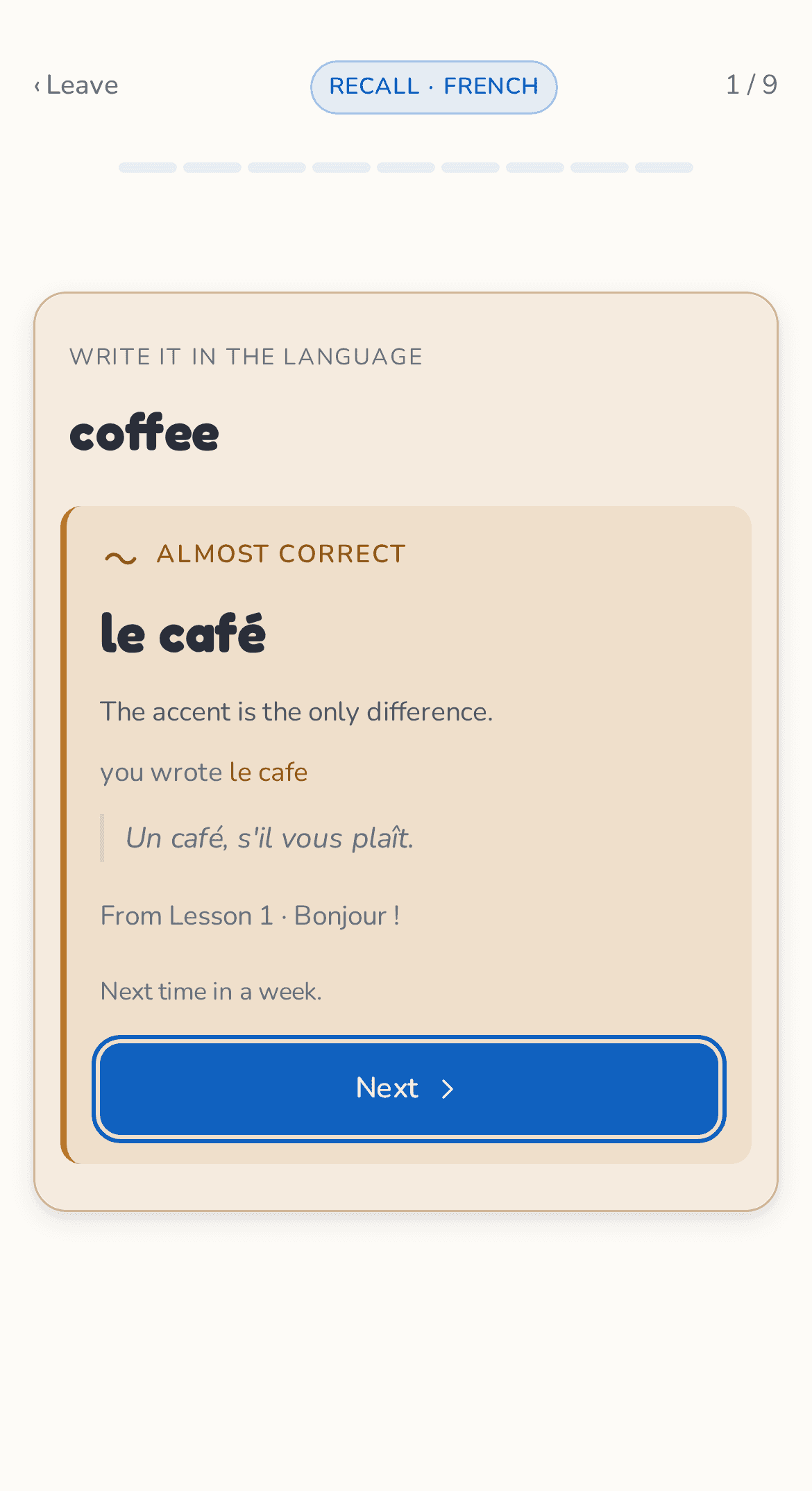
Recall is where every word you have learned comes back for review. You answer by typing, and there are no buttons for rating how well you think you knew it.
Pulling a word out of memory is the practice itself. Students who practised recalling a passage remembered more of it days later than students who reread it, though rereading left them more confident (Roediger & Karpicke, 2006 (external site)). With new vocabulary, recalling a word again helped a week later where studying it again added nothing, and the students’ own predictions bore no relation to how they did (Karpicke & Roediger, 2008 (external site)). A review of ten common study techniques rated practice testing and spaced practice the most useful of them (Dunlosky et al., 2013 (external site)).
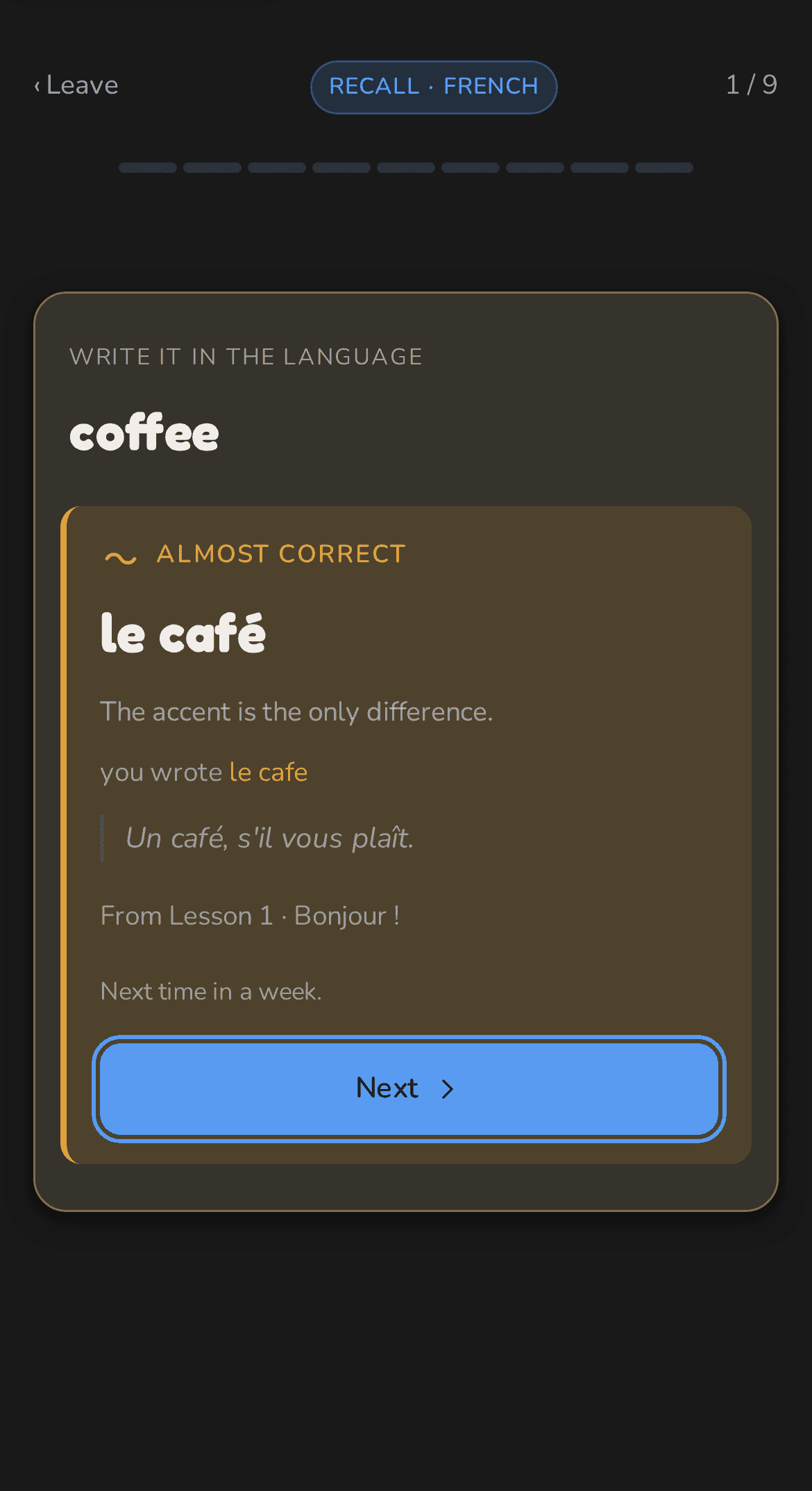
Accents, small typos and articles are forgiven, and Recall tells you what differed. When a word will not come, “Show me” gives you the answer, and you meet the word again tomorrow.


- today
- tomorrow
- 3 days
- a week
- 3 weeks
- 2 months
- 5 months
still landingholding for daysweeks to months
The ladder has seven rungs, from today to five months: short gaps first, long ones later. Forgetting is fastest soon after learning and slows after that (Ebbinghaus, 1885 (external site)), and study spread out over time is remembered better than the same study massed together (Cepeda et al., 2006 (external site)), best with gaps that grow with how long you want to remember (Cepeda et al., 2008 (external site)).
- One rung at a time
- A right answer moves a word up only when it is due, and only once a session.
- A miss starts it over
- A wrong answer sends the word back to the one-day rung.
- No reviewing early
- Recall waits until a word is due. When nothing is, you are done.
- Back after a break
- If a pile has built up, Recall says “Welcome back.” and offers to spread it over the next two weeks.
- A session
- 20 cards, about 7 minutes. Stop at any card, and every answer you give still counts.
One queue for every word
Each language has one Recall queue. The words from your lessons and the cards in your own decks come due side by side, and a session mixes them: a couple you know well to begin, then the rest shuffled so that two words from the same place rarely meet. Where a word came from is shown after you answer, never in the prompt.
Mixing can feel less tidy than one deck at a time. People learning painters’ styles did better with the paintings mixed than in blocks, and most still rated the blocks as good a way to learn, or better (Kornell & Bjork, 2008 (external site)).
Recognise, then produce
Knowing a word takes several kinds of knowledge, and recognising it when you meet it usually comes before producing it yourself (Nation, 2001 (external site)). A lesson asks for the two in that order, and saves the test for last.
- Step 2 of 10
Spot it
Recognition
A game while the words are fresh: you see each word and pick out its meaning. Match (a 4 × 4 board) or Blitz (a 60-second rush).
- Step 6 of 10
Build it
Production
After the grammar and the story: given the meaning, you build or catch the word itself. Builder (letter tiles) or Word Rain (3 hearts, 3 speeds).
- Step 9 of 10
Write it
The test
Every word of the lesson, typed in the language you are learning. No mistakes to pass.
Recall keeps the same order. On the one-day rung you see the word in the language you are learning and type what it means; from the three-day rung up, you see the meaning and write the word.
Across the week
Once a word is learned, every gap on the ladder is at least a day, so there is always a night’s sleep between one review and the next. After learning, sleep plays a part in making new memories stable, and for some skills it improves them (Walker & Stickgold, 2004 (external site)).
Spacing is also why Recall offers only what is due: your reviews spread across the week instead of piling into one sitting. In a study that ran for nine years, foreign-language words reviewed at wide gaps took slightly longer to learn and were remembered better years later (Bahrick et al., 1993 (external site)). On an evening when words are waiting, your dashboard adds one quiet line under Recall: “Reviewing before sleep helps it stick.”
- tomorrow1 night
- 3 days3 nights
- a week7 nights
…and on, a rung at a time, up to 5 months.
Study days
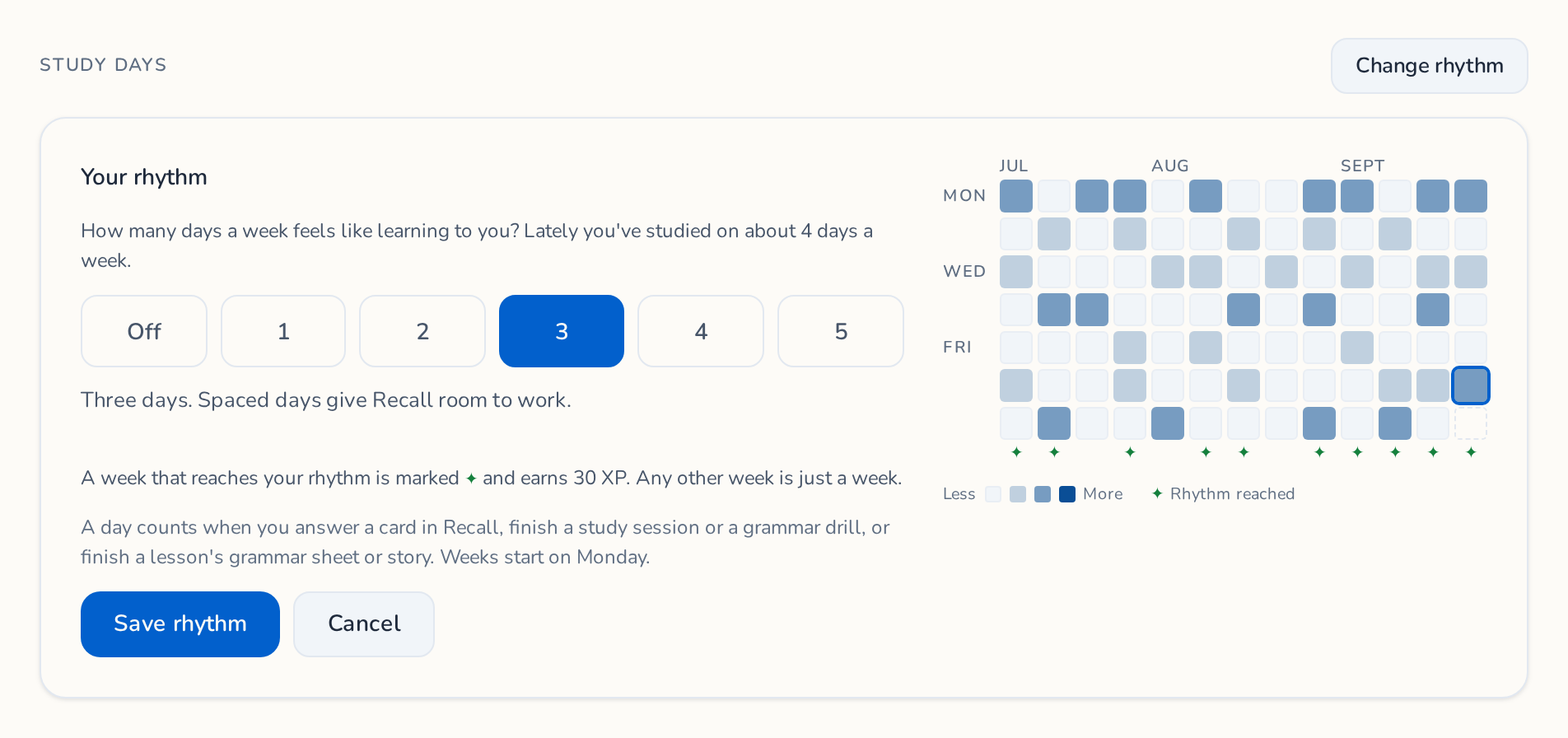
Choose how many days a week feels like learning to you, from one to five, or Off. Five is the most a rhythm asks, so two days a week always stay free, and a week that reaches your rhythm is marked with a star for good.
Nothing is lost and nothing is held against you. Your words simply wait.


Where you stand
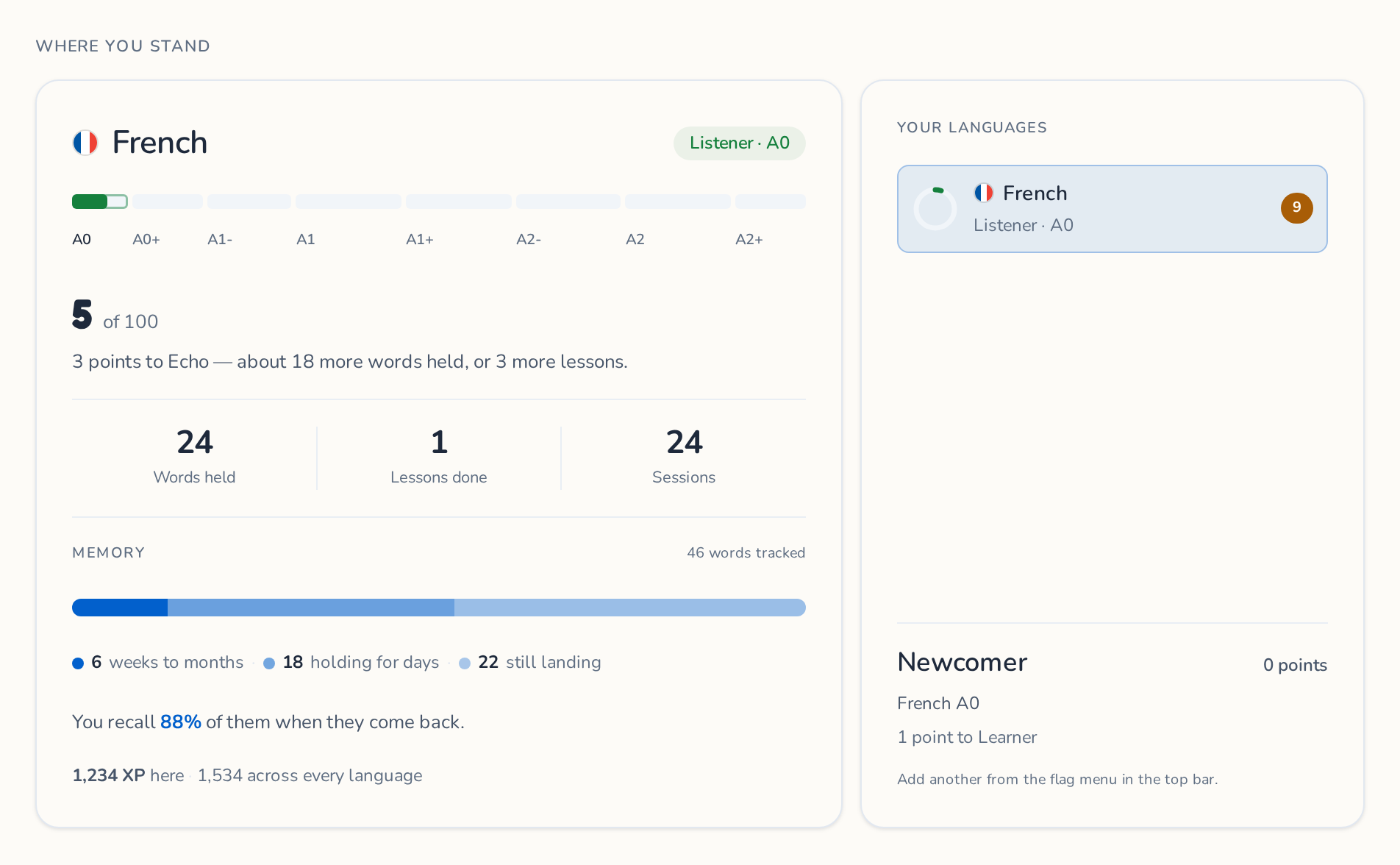
Each language you learn has a standing from 0 to 100: up to 70 points from the words you hold, and up to 30 from the lesson steps you finish.
The score falls into eight bands, from Listener at A0 to Wordsmith at A2+. Forget some words and it can dip, but a band you have reached stays yours.
Across languages, your peak bands add up to a polyglot tier, from Newcomer to Ambassador, and 33 achievements mark the milestones along the way.


Walk the ten steps yourself.
The first five lessons of every language are free, and so is Recall.